Jupiter — Lightning and Gravity Surges
630 million kilometres out. The largest planet in the solar system also brings a clear step up in difficulty, because this is the first place where two hazards run at the same time.
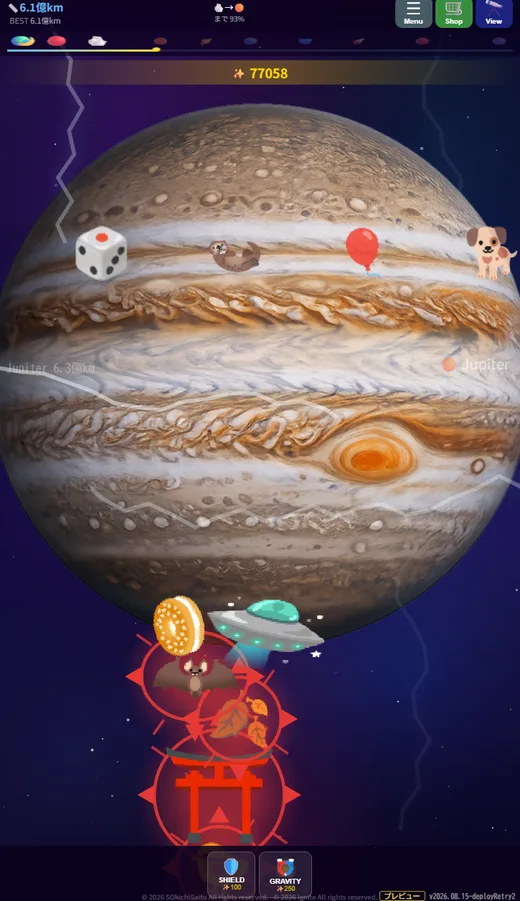
Hazard one: lightning
Lightning strikes every 8 seconds — and crucially, it does not fall randomly. It targets your tower.
- A marker appears on the targeted spot 4 seconds before the strike — time to brace, not to flee
- After the warning, a 1.5-second rush drops around 10–16 bolts in rapid succession
- A direct hit removes the struck item — but the blast also reaches 80 px outward, unfreezing up to 2 nearby bonded items and sending them flying
This means a tightly packed tower cascades harder. The more spread-out and compact your stack, the less one bolt takes down.
Hazard two: gravity surges
Every 24 seconds, a 3-second warning precedes 8 seconds of gravity at 2.4× normal strength.
This one is dangerous precisely because it is hard to see:
- Items fall faster, so your placement accuracy drops
- Extra downward load crushes joints that were holding fine before
- Once a lean starts, it accelerates faster than usual
When you see the warning, stop adding weight and just hold your shape for the full 8 seconds.
The 12-second window after entry
Knowing the exact startup timing gives you a free preparation window.
- Lightning: first strike begins about 1.5 seconds after the entry dialogue finishes
- Gravity surge: first surge hits 12 seconds after you enter the zone
That 12-second gap before the first surge is yours. Use it to flatten and stabilise your tower before the double hazard begins in earnest.
Timing reference
| Hazard | Cycle | Warning | Active phase | Shield works? |
|---|---|---|---|---|
| Lightning | Every 8 s | 4 s marker | 1.5 s rush (around 10–16 bolts, 80 px radius) | Yes ✓ |
| Gravity surge | Every 24 s | 3 s alert | 8 s at ×2.4 gravity | No ✗ |
Shield blocks lightning. It does nothing against a gravity surge.
When both land together
The two hazards run on separate cycles, so occasionally they overlap. Lightning striking a tower already straining under doubled gravity is the classic way to lose everything on Jupiter.
The answer is restraint: one or two items per cycle is the right pace here. You can chase height again after you clear the planet.
This is what Shield is for
The in-game shop description says it plainly: Shield protects your tower from meteors and Jupiter's lightning. This planet is its home turf.
Best timing: activate Shield the moment the lightning warning marker appears — that gives you the full 4-second lead-in covered. Opening the shop after the rush starts means taking hits while you browse.
Buy it before you enter the zone so you're ready. For gravity surges: Shield is useless, so when the surge warning fires, just stop placing and hold on.
If you can afford both, add Gravity. When a surge makes the tower groan, items that are pulling toward each other are far less likely to start separating. Jupiter is the one stretch where carrying both is genuinely worth it.
Common mistakes
Missing the gravity surge entirely
Lightning is loud and obvious; gravity is quiet. If items suddenly seem to fall faster, that is your signal. Train yourself to stop the moment something feels off.
Reinforcing a spot that is about to be struck
Adding an item on top of the strike marker only increases what gets thrown, and the 80 px blast will take the new item too. Let it land, then repair.
Rebuilding during the rush
During the 1.5-second burst of strikes, anything you fix gets broken again immediately. Wait it out and repair in one pass afterwards — it is faster overall.
Rushing in and stacking immediately
The first gravity surge does not arrive until 12 seconds after entry. Use that window to flatten your tower, not to race for height.
Stardust and combos
Jupiter is where you spend, not save. Losing a tower while hoarding currency is the worst outcome.
Priority is Shield first, then Gravity if you can manage it. As for combos, do not force them here — chasing a chain through lightning and heavy gravity will end badly. Earn it back in the quieter gaps of Saturn's rings instead.
Some real science
Jupiter really does have lightning; the Voyager probes observed it directly, and some flashes are far more powerful than anything on Earth.
And the gravity is no exaggeration either. Jupiter's surface gravity is roughly 2.4 times Earth's — which is exactly the multiplier the in-game surge uses. The heaviness you feel in the controls is meant to be the real number.
The giant swirl in the background is the Great Red Spot, a storm large enough to swallow the Earth that has been raging for centuries. It has outlived the entire history of telescopic observation.
Summary
- Lightning aims at you every 8 seconds. Brace when the 4-second marker appears
- Each rush drops around 10–16 bolts in 1.5 s; blast radius 80 px pulls in nearby bonded items
- During a gravity surge (×2.4 for 8 s): hold, do not build. Shield does not help here
- You have 12 seconds after entry before the first surge — use it to stabilise
- Shield's home turf. Bring Gravity too if you can