Mars — Riding Out the Iron Sandstorm
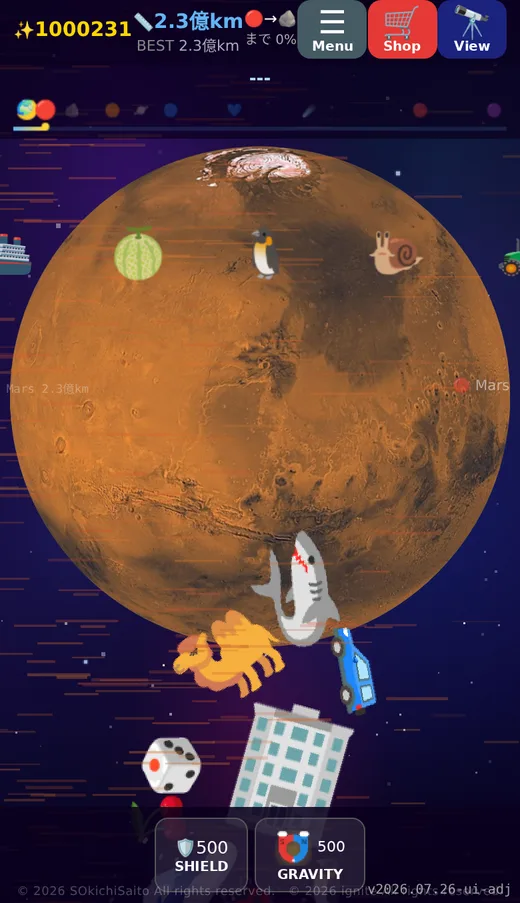
230 million kilometres from Earth. Mars is the first place where the environment actively fights back. Up to now you could stack at your own pace; here, something outside your tower starts pushing on it. In a real sense, this is where the game begins.
What happens here
Once the red planet fills the screen, a strong sideways wind begins to blow. In game we call it the rusted iron sandstorm, and it tries to shove your stacked items off to one side.
The key thing to understand is that it does not blow constantly. The storm has a clear rhythm:
- After entering the Mars zone you get exactly 4 seconds of calm before the first gust — use them
- A warning effect appears 2 seconds before the wind hits — this is your cue to stop
- The wind itself lasts 2.5 seconds
- Then 10 seconds of calm before the next one
The wind also ramps up rather than snapping to full strength, which gives you a brief window to react.
The real skill is not stacking
Most players who lose their tower on Mars make the same mistake: they keep stacking during the storm.
Falling items are affected by the wind too. You aim carefully, but by the time the item lands it has drifted sideways. That off-centre weight becomes the weak point that the next gust exploits.
- When the warning appears, stop. Doing nothing for a few seconds is the strongest play
- When the calm returns, stack fast. Ten seconds is enough for three or four items
- Never squeeze in "just one more" right before a storm — that one is usually fatal
A stacking game where the winning move is to not stack. That is what makes Mars interesting.
Shapes that survive
Against a side wind, low and wide beats tall and thin every time. The most dangerous configuration is a long item stood upright with more weight on top — leverage multiplies the force at the base.
Ideally you widen your foundation before entering the zone. When a broad item comes along, lay it flat instead of using it for height. Treat the approach to Mars as preparation time.
Also remember the basics: heavy items belong at the bottom. Light items underneath will simply slide out from under the load.
Which shop item should you bring?
For Mars, the answer is Gravity, not Shield.
Shield puts a shield around a dropped item and protects it from meteors and Jupiter's lightning — that is, from objects. The Mars storm is a force, so a shield does nothing against it.
Gravity pulls your items toward each other, holding the tower together as a single mass so it resists being pushed apart. Save your Shield for later; Jupiter is where it earns its cost.
Common mistakes
Stacking one last item before the storm
The end of a calm period is not enough time for an item to fall and settle. Decide in advance that the second half of each calm is for tidying up, not for adding weight.
Building only on one side
The wind blows from both directions. A tower leaning one way will collapse when the wind reverses. Stack across the centre line so you can take a hit from either side.
Panicking after a collapse
Fallen items are physics objects and keep rolling for a while. Dropping new items into that mess just spreads it further. Wait until things settle, then rebuild on the widest part.
Stardust and combos
Mars breaks your catching rhythm, so combos break easily here. Chasing a long combo through a storm defeats the purpose. Think of it as combo during the calm, reset during the storm. Several short safe combos beat one long risky one.
Save what you earn on Mars for Jupiter, where you will want a Shield.
Some real science
The storms are not just a game invention. Martian dust storms are real, and occasionally grow to cover the entire planet, blocking enough sunlight to shut down solar-powered rovers.
The dust is red because the surface is rich in iron oxide — literally rust. When Bibi says the storm is made of rusted iron sand, that is simply accurate.
One liberty we did take: the Martian atmosphere is less than one percent as dense as Earth's, so even fast winds carry little force. A real Martian storm would not knock you over. Ours will knock your tower over, because that is more fun.
Summary
- Storms are cyclical: warning (2 s before) → 2.5 s of wind → 10 s of calm → repeat
- Do not stack while it blows. Stack hard during the calm
- Low, wide, heavy at the bottom
- Bring Gravity; save Shield for Jupiter
The gust timeline, by the numbers
The Mars storm feels unpredictable, but the underlying cycle is precise. Here is exactly what the game does:
| Phase | Duration | What to do |
|---|---|---|
| Entry buffer | 4 seconds | Fully safe — stack aggressively |
| Warning (sand particles appear) | 2 seconds | Stop immediately |
| Gust | 2.5 seconds | Do nothing; wait it out |
| Calm | 10 seconds | Stack as fast as safely possible |
The repeating cycle — warning (2 s) → gust (2.5 s) → calm (10 s) — totals 14.5 seconds. The initial 4-second buffer happens once only on entry; every subsequent cycle follows this rhythm. Once you feel it, the stage becomes far less scary.
Shield does not help here — and that is unique to Mars
Shield deflects incoming objects. But the Mars storm is a force, not an object — the wind blows straight through any shield you put up. No other hazard planet works this way. This is the single most important thing to understand about Mars.
The correct response to a gust is simply to stop stacking. There is no shield to hide behind.
The hazard zone is the shortest of all six planets (~280 m)
The Mars gust zone runs from roughly 458 m to 738 m — about 280 metres of hazard, the shortest stretch in the game. It feels long when your tower is shaking, but if you respect the cycle and never stack during a gust, you will be through it before long.
Gust direction is random every time
The gust applies the same horizontal force to every unfrozen item regardless of size or shape. What matters is centre of gravity and base width — a low, wide base stays stable no matter which direction the wind comes from. Items that have already frozen in place are unaffected entirely, so the more of your tower is settled, the safer you are.