Saturn — Crossing the Icy Rings
The rings appear on screen at 1,792 m — 224 m before the hazard begins. They look beautiful. That is exactly when you should start worrying.
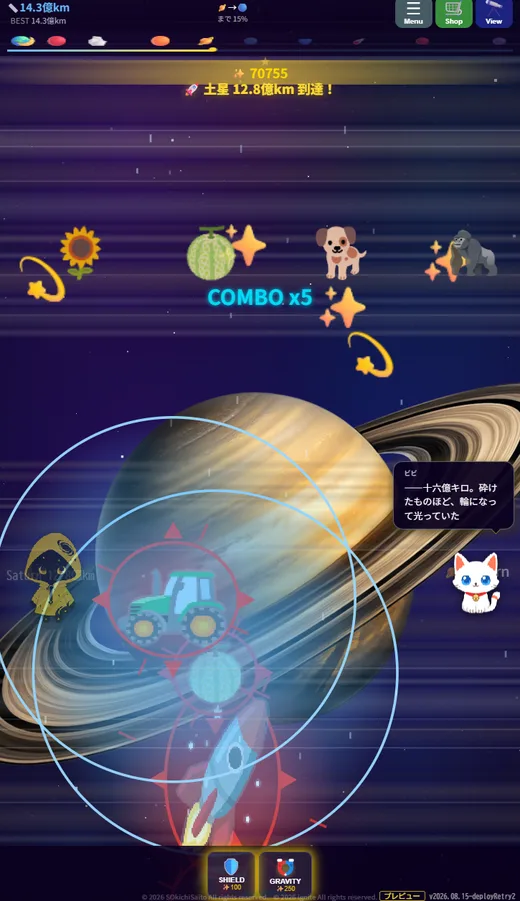
There are two rings, not one
Most players discover Ring B the hard way — by rushing through Ring A thinking the hazard is over. Here is the full altitude map:
| Zone | Altitude range | Width | Freezing |
|---|---|---|---|
| Ring A | 2,016–2,185 m | 169 m | Yes |
| Safe gap | 2,185–2,247 m | 62 m | No |
| Ring B | 2,247–2,401 m | 154 m | Yes |
The 62-metre gap between the rings is your only clear stacking window inside the hazard zone. Treat it accordingly.
A new kind of threat: freezing
Inside a ring band, items freeze over. A frozen item changes in exactly one way:
It becomes extremely slippery.
Under the hood, freezing drops friction from 8.0 to 0.1 — roughly an 80× reduction. Pieces that normally grip each other can no longer hold position. Any surface that is even slightly tilted starts to slide.
Shield does nothing against ice. The friction change is not something Shield can block. Save it for later.
The 8-second rule
Freezing is not permanent. It ends under two conditions:
- Leaving the band: friction returns to normal the moment you exit a ring
- Staying for 8 seconds: even inside a band, ice melts naturally after 8 seconds
In the worst case, 8 seconds of patience solves the problem. Placing a new item on frozen ground is almost always more costly than waiting. When in doubt, hold.
Three principles
1. Do not stack on ice
The single worst move is placing a new item on top of a frozen one. At 80× reduced friction, both slide off together. If the top of your tower looks frozen, wait — up to 8 seconds at most.
2. Prepare a flat surface
Whether a frozen item slides depends on how level the contact surface is. Slightly tilted means sliding; properly flat often survives the freeze untouched.
So the preparation happens before you arrive. Level off your tilted sections with flat items and you can cross the ice bands largely intact.
3. Use the safe gap — and the space above Ring B
The 62-metre safe gap (2,185–2,247 m) is the best stacking window inside the hazard zone — no ice, no restrictions. Stack aggressively here. Once you clear Ring B at 2,401 m, the hazard ends entirely. Think of the rings as stripes with usable gaps, not a solid wall.
Common mistakes
Not noticing the freeze
The visual change is subtle, so players stack on ice without realising. Get in the habit of looking at your top item before each drop.
Adding weight to stop a slide
Instinctive, but counterproductive: more weight on 80× reduced friction means more sliding force. Once something starts to go, let it go and protect what remains.
Thinking Ring A is the only ring
Exiting Ring A at 2,185 m gives only 62 metres of safety. If you immediately race upward, you enter Ring B at 2,247 m before the momentum stops. Know the gap length and use it deliberately.
Rushing through the rings
The spectacle makes you want to hurry, but hurrying means slipping. Waiting for the gaps and then climbing hard gets you through faster.
Stardust and combos
Saturn is a good place to rebuild the stardust Jupiter drained. Inside the safe gap and above Ring B there is little interference, so combos can run cleanly.
Gravity is the item of choice here — bound items hold together even when friction drops. Shield does nothing against ice, so save it for the next stretch.
Also: once you reach Saturn, save your game. Losses get expensive from here, and having a save point lets you take risks with a clear head.
Some real science
Saturn's rings are mostly water ice — particles ranging from grains of sand to chunks the size of a house, all orbiting the planet. What you see is sunlight reflecting off ice.
How did they form? A leading idea is that a moon or passing body strayed too close and was torn apart by tidal forces. Inside a certain distance from a planet, an object's own gravity can no longer hold it together.
When Bibi remarks that the things which were broken are the ones that shine as a ring, that is what she means. Saturn is written as the planet where broken things become the most beautiful.
One more astonishing fact: the rings span hundreds of thousands of kilometres across but are only tens of metres thick on average. Seen edge-on, they nearly disappear.
Summary
- Two rings: Ring A (2,016–2,185 m) and Ring B (2,247–2,401 m)
- 62-metre safe gap (2,185–2,247 m) between them — stack there
- Freezing cuts friction by ~80×; any tilt becomes a slide
- Ice melts in 8 seconds max — waiting beats stacking on ice
- Shield is useless here. Save it. Use Gravity instead