Uranus — Storms and Diamond Rain
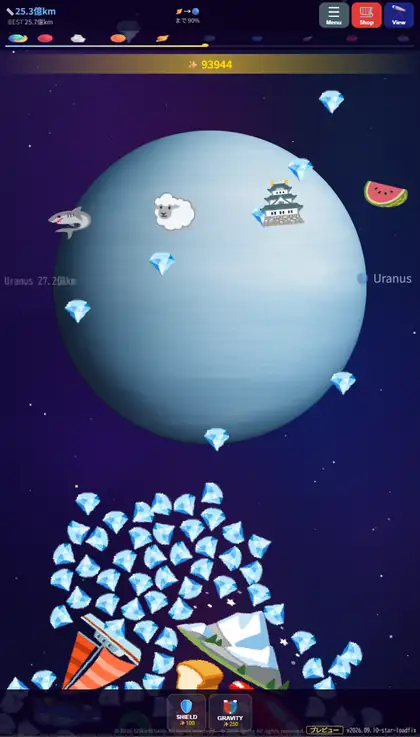
2.7 billion kilometres out. The Sun is now just a slightly brighter star. Two things wait for you at this cold blue planet: a storm, and falling diamonds.
⚡ The most important thing on this page: the storm only tilts the drop zone
When the storm hits, the screen appears to tilt — but your stacked tower does not move at all. The tilt affects only the visual indicator for where items fall. "The tower sways" is a misconception. Overcorrecting your taps makes it worse: when the tilt reverses, you overshoot in the opposite direction.
Hazard one: sudden storms
Shortly after entering the zone, storms begin. They resemble the Martian sandstorm, but the gap between warning and impact is shorter, so reacting is harder.
The screen flashes to announce the storm. Do not miss that cue. If you have built the habit of stopping when a warning appears, Uranus is simply that habit applied faster.
- Flash = stop stacking
- During the storm, focus on holding the tower you have
- Rebuild once it passes
The storm's rhythm
Once you enter the zone, the storm follows this repeating cycle:
| Phase | Duration | What to do |
|---|---|---|
| Wait (on entry) | ~3 seconds | Stack normally — the drop zone is straight |
| Tilt ON | 4 seconds | Minimal correction only — or just pause |
| Rest | 8 seconds | Drop freely. This is your main stacking window |
| Tilt ON (repeats) | every 4 s | Minimal correction again |
The 8-second rest is your opportunity. Stack aggressively during the quiet windows; hold back during the 4-second tilts. The tilt angle reaches ±18° (a sine wave at roughly 2 s period), but it never touches the physics of the tower itself.
Common mistake: If you chase the tilt with a big correction, the next half-cycle swings the opposite way and your tap is now wrong in the new direction. Keep corrections small.
Hazard two: diamond rain
Glittering particles fall through this zone. This is not merely decorative — it is based on a phenomenon scientists believe actually occurs on Uranus.
Practically speaking, it means the screen gets busy. The real danger may be that the spectacle pulls your attention away from your tower. Keep your eyes on the stack.
Diamonds are real stackable items
The falling diamonds are treated as ordinary items: they land on your tower and contribute to its height. They start raining the moment you enter the zone, spawning one every 80–170 ms with up to 20 on screen at once. Think of them as a bonus item stream — good drop positions during the 8-second rest windows can add meaningful height fast.
No Shield needed — save your stardust
Neither Uranus hazard can be countered with a Shield.
- Storm tilt — it is a display effect; a Shield has no bearing on it
- Diamond rain — diamonds are normal items; a Shield does nothing to them
This means Uranus is a stage where spending stardust on a Shield gains you nothing. Hold your reserves. There are upcoming stages where a Shield makes the difference. Read the rhythm, stack during the rest windows, catch the diamonds — that is all you need here.
Advice for players who got this far
If you have reached Uranus, your fundamentals are solid. What separates runs from here on is tower design.
- Centre of gravity over height. A collapse at this depth costs far more than before
- Do not run your stardust to zero. Harder stretches are still ahead and you will want a Shield
- Use your saves. When your tower is in good shape, save. A near-miss collapse becomes recoverable
Common mistakes
Over-correcting for the tilt
Chasing the tilt with a large tap adjustment is the most damaging habit. The tilt reverses every ~2 seconds — a big correction made at one extreme leaves you just as wrong at the other extreme. Small adjustments only, or stop entirely and wait for the 8-second rest.
Treating the flash as decoration
The warning style differs from earlier planets, so first-time players often read it as an effect rather than an alarm. Learn it as: light means stop.
Losing focus in the diamond rain
There is a lot on screen. The background can be ignored entirely — keep your eyes on the top of the tower and Uranus becomes much calmer.
Getting sloppy from a sense of achievement
Reaching Uranus feels like an accomplishment, and judgement slips. In truth this is exactly when you should increase your caution.
Stardust and combos
At this depth a single collapse costs a lot of altitude, so the policy is simple: preserve rather than push.
Chase combos only in the quiet stretches between storms. Forcing a chain into a storm is the most wasteful way to lose a good run.
Keep enough stardust for at least one Shield. If you drop below that, prioritise combos and rebuild your reserve.
Some real science
What makes Uranus unique is that its axis is tipped almost completely over — about 98 degrees, so it rotates lying on its side relative to its orbit.
The suspected cause is a collision: something large struck the young planet and knocked it down.
That posture produces extraordinary seasons. Uranus takes about 84 years to orbit the Sun, which means its polar regions get roughly 42 years of continuous daylight followed by 42 years of night. A human lifetime spans only a handful of seasons there.
As for the diamonds: deep inside Uranus and Neptune, methane is thought to break down under crushing pressure and heat, with the carbon forming diamond that sinks toward the core. Laboratory experiments using high-powered lasers have produced tiny diamond crystals under similar conditions. Somewhere down there, it may genuinely be raining diamonds — which is why we put them on screen.
Summary
- The flash is the warning. Stop when it appears
- Do not let the diamond rain steal your focus
- At this depth, preserve rather than push. Keep stardust and save often